
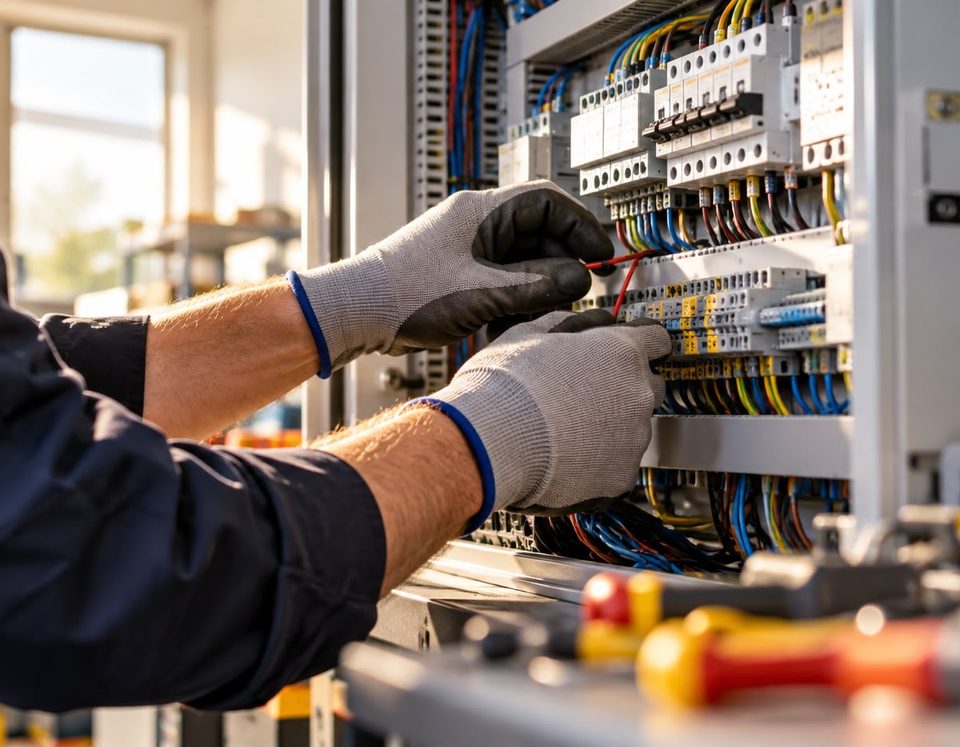
Duties and workplaces
Electricians install, test and maintain electrical systems. This includes cabling, distribution boards, lighting and connecting equipment. In new buildings they work to plan, in existing buildings they trace faults and carry out conversions.
In the crafts, electricians often work on building sites and at customers' premises. In industry they look after machines and systems in the plant. Who may carry out which work depends on the task.
Safety comes first in all of this. Safety briefings, switching authorisations and test records are part of everyday work.
- Electrical trades in new and existing buildings
- Industrial companies with their own maintenance
- Building services and plant engineering
- Customer service and maintenance
Recognition
Non-regulated occupation
Depending on the reference occupation, the Chamber of Skilled Crafts or the Chamber of Industry and Commerce is responsible.
The occupation is not regulated in Germany. A company can hire an electrician with a foreign certificate without that certificate being recognised. For people from countries outside the EU, however, the residence title comes into play.
The title as a skilled worker usually requires the qualification to be equivalent to a German one. Recognition thus becomes a condition for entry. In certain cases work experience can also lead to employment, under additional conditions set out by the official bodies.
A chamber is responsible. Electrical occupations exist in the crafts and in industry. Craft occupations are assessed by the Chamber of Skilled Crafts, industrial occupations by the Chamber of Industry and Commerce. The German reference occupation decides which chamber handles the application.
The route starts at the portal Recognition in Germany. It lists German occupations with their content and the responsible office. The chamber assesses the qualification and issues a decision. If differences remain, the decision names them, and there are ways to make them up.
As a rule, the skilled worker submits the application personally. Only the responsible chamber decides on equivalence. Nobody promises a result or a time frame.
German language skills
Safety briefings are held in German and must really be understood. On building sites and at customers' premises, arrangements come on top. There is no fixed level for everyone, however.
What is required depends on the residence title, on the position and on the company. The responsible office or the company states it in the individual case. A basic level is often enough to start if the company supports the induction.
We record the candidates' language level on the European scale from A1 to C2 and ask for proof.
Documents
We ask electricians for these documents. Proof of occupational safety training helps you with the induction.
- required CV Including types of installation, voltage levels and projects.
- required Trade certificate or equivalent qualification Your electrical qualification, together with a translation.
- if available Employment references Proof of your years in the trade and the systems involved.
- if available German language certificate Safety briefings are held in German.
- if available Occupational safety records Briefings, switching authorisation or work at height, if you have them.
The list is a general guide and creates no legal entitlement. The responsible office and the company say what is required in the individual case.
Training in Uzbekistan and Türkiye
Türkiye
In Türkiye vocational education usually starts at vocational upper secondary schools, often with an electrical focus. There are also short job-related programmes at universities, which are widespread in technical fields. Whether a qualification is equivalent is checked case by case by the responsible chamber.
Uzbekistan
In Uzbekistan vocational training runs through colleges and technical schools with a lot of practice, including in technical fields. Many candidates have also learned their trade on the job. Qualifications from colleges and universities are assessed individually.
How it works with Regalis
-
1
Taking up your needs
You describe the duties, systems, workplaces and accommodation. We ask questions wherever something is unclear.
-
2
Search in our own network
Our local partners approach electricians, ask about qualifications, certificates and experience and review the documents.
-
3
Presenting checked profiles
You receive profiles without names and decide whom you want to talk to. A short task on video can follow.
-
4
Coordinating the documents
We coordinate the documents for recognition, employment, entry and residence.
-
5
Support until the first working day
We stay at your side until the first working day and remain available in the first months.
For skilled workers
Are you an electrician in Türkiye or Uzbekistan and would like to work in Germany? Send us a quick application or create a profile. Our service is free of charge for candidates. The page on your country of origin shows the route to Germany step by step. You sign the employment contract directly with the company. You apply for the visa at the German mission abroad, which decides on it.
- Apply in short
- From Türkiye For skilled workers from Türkiye: the route to Germany step by step, documents, learning German, fair recruitment and protection from fake agents.
- From Uzbekistan For skilled workers from Uzbekistan: the route to Germany step by step, documents, learning German, fair recruitment and protection from fake agents.
Frequently asked questions about this occupation
May an electrician work for us without recognition?
The occupation is not regulated. For the visa as a skilled worker, however, the qualification usually has to be equivalent.
As of: October 2026 · Source: Recognition in Germany, German federal law online
Which chamber assesses a qualification as an electrician?
That depends on the German reference occupation. Craft occupations are assessed by the Chamber of Skilled Crafts, industrial occupations by the Chamber of Industry and Commerce.
As of: October 2026 · Source: the responsible Chamber of Skilled Crafts, Chambers of Industry and Commerce
Which safety documents are helpful?
Safety briefings, switching authorisations or proof for work at height, where available. We ask for them and record what is proven.